


Virtual Flooring Visualizer: The Smart Way to Choose the Perfect Floor Before You Buy
Choosing the right flooring has always been one of the most difficult decisions in any home or commercial project. You’re not just picking a material — you’re deciding the entire look, feel, and mood of a space. And once it’s installed, there’s no easy going back.
That’s exactly why the virtual flooring visualizer is changing the game.
Instead of imagining how a tile, wood, or vinyl will look in your room, you can now see it instantly. Real room. Real lighting. Real scale. This shift is not just improving customer experience — it’s fundamentally transforming how flooring brands sell and how buyers make decisions.
In this article, I’ll break down what a virtual flooring visualizer is, why it matters, and how it’s becoming a must-have tool for modern flooring businesses.
What Is a Virtual Flooring Visualizer?
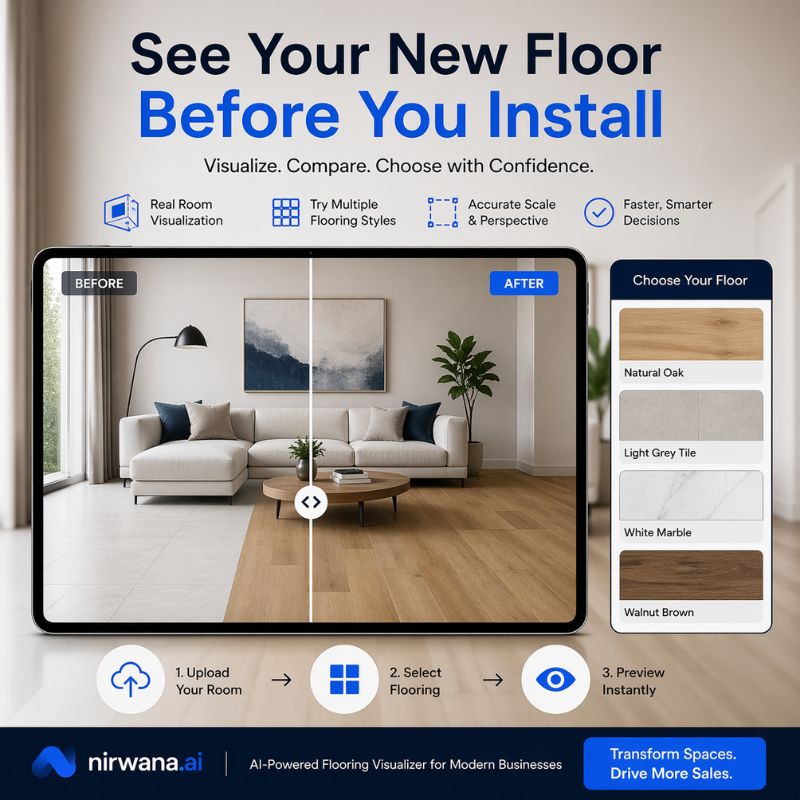
A virtual flooring visualizer is an AI-powered tool that allows users to upload a photo of their space or choose a preset room, and then apply different flooring options to see how they look in real time.
Instead of guessing, customers can:
- Try multiple flooring styles instantly
- Compare colors, textures, and patterns
- See accurate scale and placement
- Make faster, more confident decisions
It removes uncertainty from one of the biggest purchase decisions in home improvement.
Why Traditional Flooring Selection Doesn’t Work Anymore
Limited imagination leads to hesitation
Most buyers struggle to visualize how a flooring sample will look across an entire room. A small sample tile or wood plank simply doesn’t translate into a full-space experience.
Expensive mistakes
Once flooring is installed, changing it is costly and time-consuming. This fear often delays decisions or leads to safer, less exciting choices.
Slow decision-making process
Customers visit showrooms, compare options, go back home, and still remain unsure. This creates long sales cycles and lost opportunities for brands.
How a Virtual Flooring Visualizer Solves These Problems
Real-time visualization in actual spaces
The biggest advantage of a virtual flooring visualizer is realism. Customers can see exactly how a product will look in their own room, with proper perspective and lighting.
Faster and more confident buying decisions
When customers can visualize clearly, they don’t hesitate. This directly improves conversion rates and reduces drop-offs.
Reduced dependency on physical showrooms
With a digital experience, brands can showcase their entire catalog online without needing large physical displays.
Key Features That Make a Good Virtual Flooring Visualizer
Accurate scaling and perspective
A strong visualizer ensures that flooring is applied in the correct proportions, matching the room’s layout and angles.
Realistic textures and lighting
High-quality tools replicate natural light, shadows, and surface finishes so the output looks as close to reality as possible.
Pattern alignment and layout control
For materials like tiles or wooden planks, alignment matters. Advanced tools allow users to preview patterns, rotations, and layouts.
Easy user experience
The tool should be simple:
- Upload image
- Select product
- Apply and preview
The smoother the flow, the higher the engagement.
Real-World Use Cases
For homeowners
Imagine a homeowner planning to renovate their living room. Instead of visiting multiple stores, they upload a photo of their room and try different flooring styles instantly.
They can:
- Compare light wood vs dark wood
- Test marble vs tiles
- Match flooring with furniture
This leads to faster decisions and higher satisfaction.
For flooring brands
For brands, a virtual flooring visualizer is not just a feature — it’s a sales engine.
It helps them:
- Increase website engagement
- Reduce dependency on physical samples
- Improve conversion rates
- Stand out from competitors
Brands using tools like Nirwana.ai are already seeing how digital visualization can replace traditional selling methods.
For retailers and showrooms
Retailers can use the visualizer inside their stores as well. Instead of just showing samples, they can create an interactive experience where customers see their selected flooring applied instantly.
This improves:
- In-store engagement
- Customer trust
- Sales closing rates
Benefits for Businesses
Higher conversions
When customers can see the final result, they are more likely to buy. A virtual flooring visualizer removes doubt and builds confidence.
Shorter sales cycles
Visualization speeds up decision-making, reducing back-and-forth and follow-ups.
Better customer experience
Customers feel more in control of their choices, which improves overall satisfaction.
Competitive advantage
In today’s market, brands that offer interactive experiences stand out immediately. Visualization is no longer optional — it’s expected.
How AI Is Making Visualizers Even More Powerful
Modern tools are no longer just simple overlays. With AI, a virtual flooring visualizer can now:
- Automatically detect floor areas
- Adjust textures based on lighting
- Maintain realistic depth and perspective
- Improve image quality for better output
This level of intelligence makes the experience seamless and highly accurate.
Nirwana.ai, for example, is pushing this further by combining AI with realistic rendering to create near real-life previews, helping brands deliver premium experiences online.
Common Mistakes to Avoid
Poor quality visuals
If the output looks fake or misaligned, users lose trust instantly.
Complicated interface
If the tool is hard to use, users won’t engage. Simplicity is key.
Limited product catalog
A visualizer is only as strong as the options it provides. Brands need to ensure their full catalog is available.
The Future of Flooring Selection
The shift is clear.
Customers no longer want to imagine — they want to see.
As more brands adopt digital tools, the virtual flooring visualizer will become a standard part of the buying journey. It will not just support decisions, but drive them.
In the next few years, we’ll see:
- Deeper AI integration
- Real-time customization
- Fully interactive buying experiences
Conclusion
A virtual flooring visualizer is not just a tool — it’s a transformation in how flooring is sold and purchased.
It removes uncertainty, speeds up decisions, and creates a better experience for both customers and businesses.
If you’re a flooring brand, retailer, or even a homeowner planning a renovation, this technology is something you simply can’t ignore.
The sooner you adopt it, the faster you stay ahead.
If you want to explore how this can work for your business, it might be worth trying a modern solution like Nirwana.ai and seeing the impact firsthand.