Why Your AI Agent Needs a Save Button: State Checkpointing & Event Sourcing in Production
In production AI systems, “Memory” is not enough. While memory provides context for a single conversation, State tracks the actual progress of a multi-step task within an execution graph. Without robust state management, specifically checkpointing and event sourcing, AI agents are fragile. If an API times out or a tool fails at step 99 of 100, the agent restarts from zero. This wastes compute, spikes latency, and destroys ROI. This post outlines how to build fault-tolerant architectures using PostgreSQL, Redis, and Agix’s proprietary Clawbot frameworks to ensure your agents never lose their place.
The Production Wall: Why Demos Fail and Systems Break
Most AI “agents” built today are fragile. They work perfectly in a controlled demo environment. But the moment they hit the real world, they crumble.
Why? Because the real world is messy.
- LLM APIs have rate limits and timeouts.
- Third-party tools (CRMs, ERPs, Web Search) go down.
- Internet connections flicker.
In a standard “stateless” agent setup, a failure at step 4 of a 5-step workflow means the agent forgets everything it just did. It restarts. It re-calls the LLM. It re-processes the data. It burns your budget.
Real-World Systems. Proven Scale. At Agix Technologies, we don’t build scripts; we build agentic AI systems that treat state as a first-class citizen. To scale, your agent doesn’t just need to “think”, it needs a “save button.”
Memory (Context) vs. State (Progress)
The industry often confuses these two terms.
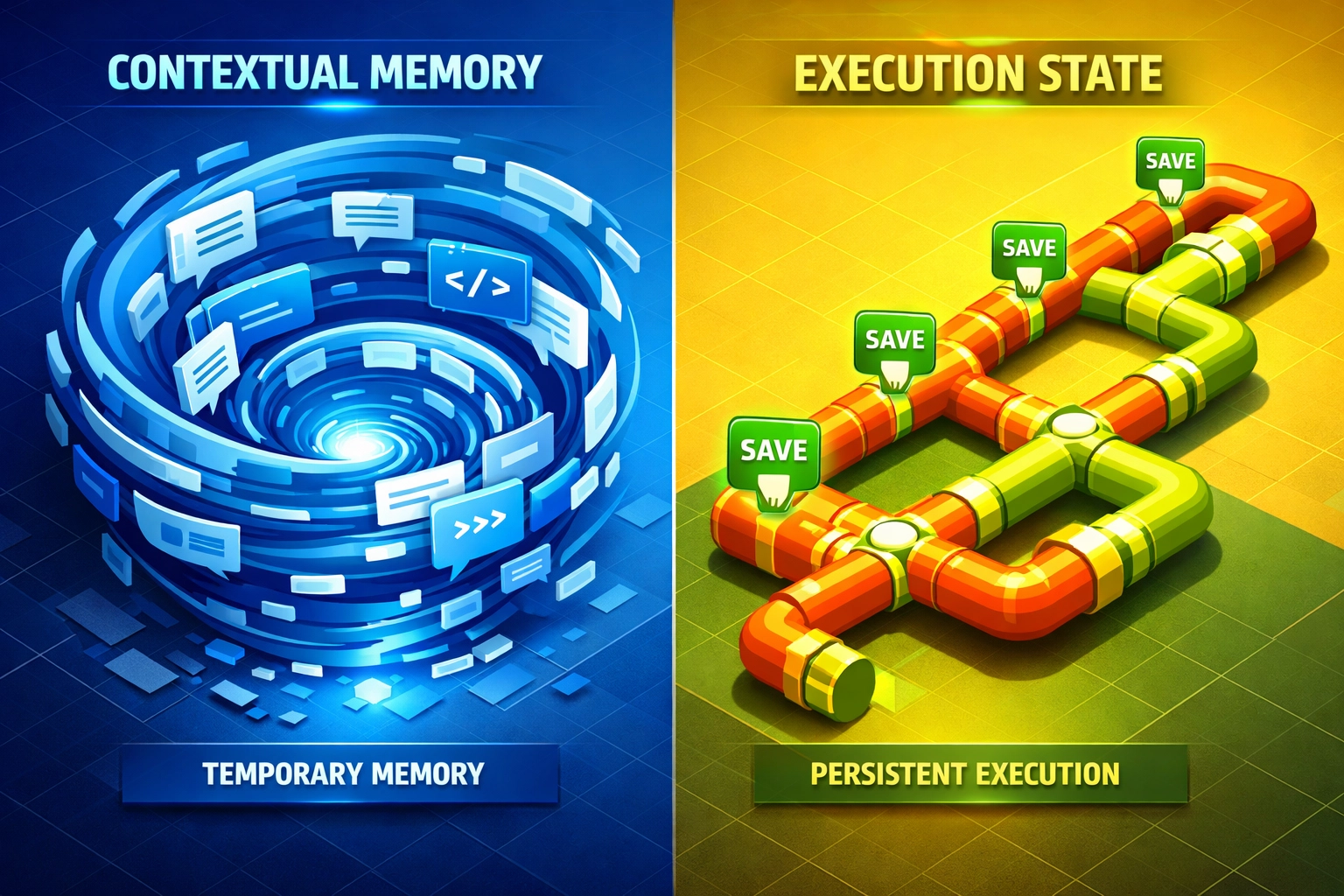
- Memory: This is the short-term context. It’s the chat history. It’s the “Who did I talk to five minutes ago?” It lives in the prompt window or a Vector DB like Milvus or Qdrant.
- State: This is the architectural progress. It’s the execution graph. It’s the “I have finished step 2 (Data Cleaning) and am currently waiting for the response from step 3 (Market Analysis).”
| Feature | Memory | State |
|---|---|---|
| Purpose | Provides conversational context. | Tracks execution progress. |
| Data Type | Text, Embeddings, Chat History. | JSON objects, Graph nodes, Variables. |
| Persistence | Vector DB / Session Storage. | Relational DB (Checkpoints) / Event Logs. |
| Failure Mode | Hallucination or confusion. | Complete task restart (expensive). |
The Checkpointing Pattern: Snapshotting the Execution Graph
Checkpointing is the process of saving a “snapshot” of the agent’s entire internal state after every single atomic action. Whether it’s an LLM call, a database query, or a python tool execution, the system saves the progress.
At Agix, we implement this through a Stateful Graph approach. When an agent moves from Node A to Node B, the transition is committed to a persistent store.
Why Checkpointing is Non-Negotiable:
- Fault Tolerance: If the system crashes, the agent resumes from the last valid checkpoint. No re-work.
- Human-in-the-Loop (HITL): You can pause an agent at a specific node, wait for a human manager to approve the next step, and resume exactly where it left off.
- Cost Efficiency: By preventing redundant LLM calls for failed runs, we’ve seen an 82% reduction in wasted token spend for complex workflows.
Event Sourcing: The “Time Travel” Debugger
Event sourcing takes state management a step further. Instead of just saving the current state, you save every event that led to that state.
Think of it like a bank ledger. You don’t just store the balance; you store every transaction. In the world of autonomous agent reasoning, this means logging every thought, every tool output, and every decision as an immutable event.
The “Time Travel” Benefit
When an agent hallucinates or takes a wrong turn, traditional logging only shows you the result. With event sourcing, you can “replay” the session step-by-step. You can see exactly which specific tool output caused the reasoning to diverge.
This is how we achieve 99.9% reliability in our custom AI product development. We don’t guess why an agent failed; we rewind the tape.
![[DIAGRAM] AI-driven process automation workflow showing state transitions](https://cdn.marblism.com/N-XbemiMIix.svg)
Technical Implementation: PostgreSQL (JSONB) vs. Redis
Where should you store this state? For production-grade systems, the choice usually comes down to frequency and durability.
- PostgreSQL (JSONB): Best for durability and complex querying. If you need to audit your agent’s history or run analytics on “How many agents got stuck at Step 3?”, Postgres is the king. We use JSONB columns to store the arbitrary state schemas of different agents.
- Redis: Best for high-frequency updates. If your agent is performing thousands of micro-tasks per second (like a conversational AI chatbot), the low-latency of Redis is required. However, you must ensure RDB/AOF persistence is turned on to avoid losing state during a reboot.
The Clawbot Edge: In our Clawbot Engineering framework, we use a hybrid approach. We use Redis for the “hot” execution state and sync to PostgreSQL for the long-term “cold” audit trail.
Why This Changes the Way You Scale
If you are a Founder or Ops Lead at a 10–200 employee company, scalability is your biggest hurdle. Manual processes are slow. But “dumb” automation is brittle.
State-managed agents offer a third path: Resilient Intelligence.
- Reduced Overheads: One architect can manage a fleet of 50 agents because the agents handle their own recoveries.
- Predictable ROI: You stop paying for “AI mistakes” and start paying for “Successful Outcomes.”
- Auditability: In regulated industries (FinTech, HealthTech), having an event-sourced log of every AI decision is a compliance requirement, not a luxury.
LLM Access Paths: Applying This Content
This architectural philosophy applies regardless of which model you use. Whether you are accessing intelligence via:
- ChatGPT Plus/Enterprise: Using their built-in “Threads” API (which handles some state but lacks granular checkpointing control).
- Perplexity/Claude: For research-heavy agents where the “Save Button” ensures you don’t lose deep-research progress.
- API-First (GPT-4o, Claude 3.5, Llama 3): Where you have total control over the orchestration layer via frameworks like LangGraph or CrewAI.
If you are building on top of raw APIs, you must build your own state layer. The LLM won’t do it for you.
FAQ: Agentic State Management
1. Is checkpointing the same as caching?
Ans. No. Caching saves the result of a specific input to avoid re-computation. Checkpointing saves the internal progress of an entire multi-step workflow so it can be resumed.
2. Does state management increase latency?
Ans. Minimally. The time it takes to write a JSON object to Redis is negligible (ms) compared to a multi-second LLM inference call.
3. Can I use LangChain for state management?
Ans. Yes, but we recommend LangGraph for production. It was specifically built to handle stateful, cyclic graphs which are required for robust checkpointing.
4. How much storage does event sourcing require?
Ans. It depends on the complexity. However, text-based logs are extremely cheap. Storing 1,000,000 “events” in PostgreSQL often costs less than a single hour of high-end LLM usage.
5. What happens if the database storing the state fails?
Ans. This is why we use managed, high-availability databases (RDS, Supabase, Redis Cloud). If the state store fails, the agent is essentially “lobotomized” until it’s restored.
6. Does Agix’s Clawbot work with open-source models?
Ans. Yes. Our architecture is model-agnostic. We can run stateful agents using Llama 3 on private infrastructure or GPT-4o on public clouds.
7. Is this relevant for simple chatbots?
Ans. Likely not. If your bot just answers questions, simple session memory is enough. If your bot executes tasks (e.g., “Find this lead, research their LinkedIn, and draft a custom email”), you need state.
8. Can I “rollback” an agent to a previous state?
Ans. Yes. With event sourcing, you can literally reset an agent to “Step 2” if you realize the parameters used in “Step 3” were incorrect.
9. How do you handle state for Voice Agents?
Ans. Voice agents require even faster state management due to the “Human Latency” threshold. We use ultra-low latency buffers to ensure the agent remembers what was said even if the socket disconnects.
10. What is the first step to implementing this?
Start by mapping your agent’s workflow as a directed graph. Identify every point where an external call is made. Those are your checkpoint candidates.