Why Lidar Scan to BIM Services Boost Construction ROI?
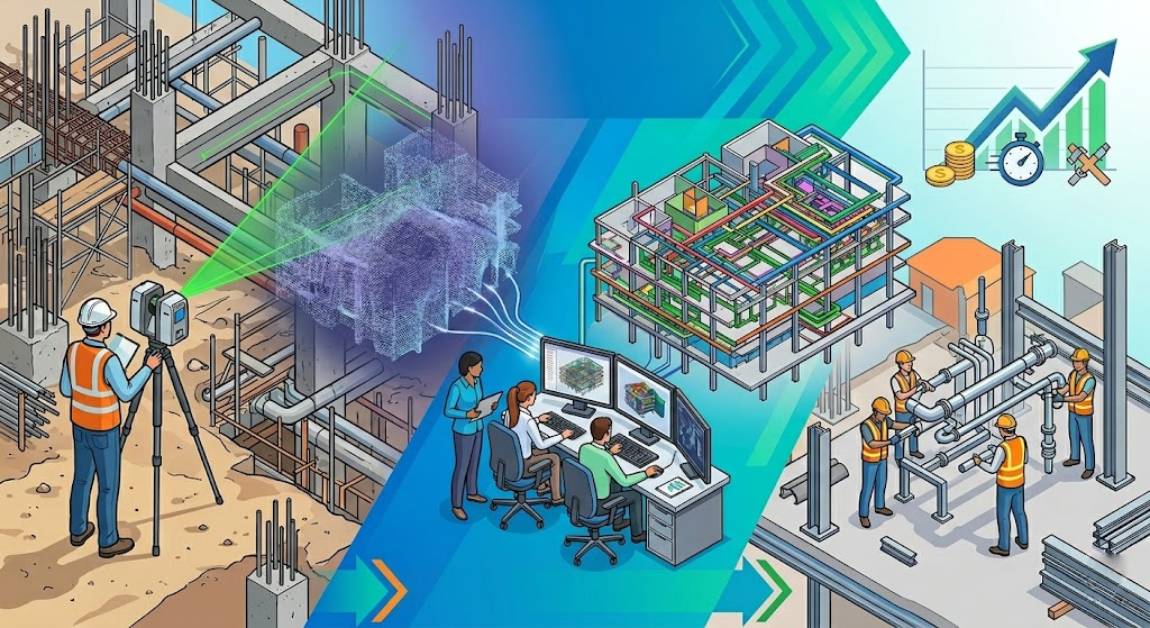
In today’s competitive construction landscape, profitability depends on precision, speed, and informed decision-making. Projects are becoming more complex, timelines tighter, and margins slimmer. In this environment, digital transformation is no longer optional it’s essential. One of the most impactful technologies driving measurable returns is Lidar-based reality capture integrated with BIM workflows.
By converting laser-scanned site data into intelligent 3D models, companies can reduce errors, prevent rework, and streamline project execution. That’s why many forward-thinking firms are investing in Lidar Scan to BIM Services to maximize construction ROI from design through facility management.
The Role of Accurate Site Data in Maximizing ROI
Understanding the Link Between Accuracy and ROI
Return on investment in construction is heavily influenced by how well a project is planned and executed. Inaccurate site measurements, outdated drawings, or undocumented changes can quickly lead to:
- Costly design revisions
- Material waste
- Project delays
- On-site conflicts
- Increased labor expenses
Lidar technology captures millions of data points to create highly accurate point clouds. When transformed into BIM models, this data becomes a reliable foundation for design, coordination, and construction planning. The more accurate the starting data, the lower the financial risk.
This precision directly translates into stronger financial performance.
Minimizing Rework and Cost Overruns
Rework is one of the biggest threats to construction profitability. Even minor discrepancies between design drawings and actual site conditions can lead to significant budget overruns.
Using advanced scanning methods, project teams can detect structural deviations, misalignments, and hidden elements early in the process. When these insights are integrated into digital models, teams can resolve conflicts before construction begins.
With the support of Scan to BIM Services, stakeholders gain access to as-built models that reflect real-world conditions. This reduces change orders, improves design accuracy, and minimizes unexpected site modifications all of which protect project margins.
Faster Decision-Making Through Real-Time Insights
Time is money in construction. Delays impact labor schedules, equipment rentals, and overall project timelines.
Lidar scanning accelerates data collection compared to traditional manual surveys. Large sites can be captured in hours instead of days, providing immediate digital documentation. When converted into structured BIM models, the information becomes accessible and actionable.
This speed enables:
- Faster design validation
- Quicker clash detection
- Improved stakeholder communication
- More efficient approvals
By shortening the preconstruction phase and improving collaboration, companies can reduce project durations and increase overall profitability.
Improved Coordination Across Disciplines
Modern construction projects involve multiple teams architects, structural engineers, MEP designers, contractors, and facility managers. Miscommunication between disciplines often leads to conflicts, delays, and cost escalations.
Lidar-based BIM models act as a single source of truth. All stakeholders work from the same verified dataset, minimizing misunderstandings and improving alignment.
For renovation and retrofit projects especially, having accurate digital representations of existing conditions eliminates guesswork. Teams can confidently design modifications without worrying about hidden surprises behind walls or above ceilings.
Better coordination means fewer disputes, smoother workflows, and stronger ROI.
Enhanced Risk Management
Construction projects carry inherent risks—financial, operational, and safety-related. Incomplete or inaccurate documentation increases those risks.
By leveraging detailed scanning and modeling, project teams gain comprehensive visibility into site conditions. This reduces uncertainty and improves forecasting accuracy.
Risk mitigation benefits include:
- Fewer unexpected structural issues
- More accurate quantity takeoffs
- Better budgeting and cost estimation
- Reduced safety hazards from undocumented elements
When risks decrease, profit margins become more predictable and stable.
Supporting Renovation and Facility Management
Existing buildings often lack accurate documentation. Over time, renovations, repairs, and modifications make original drawings unreliable.
Digitizing these structures with Lidar Scan to BIM Services creates updated as-built models that can be used for:
- Space planning
- Energy efficiency upgrades
- Maintenance planning
- Asset management
Facility owners benefit from long-term operational savings, while contractors reduce uncertainty during renovation work. This lifecycle value significantly enhances overall ROI beyond the initial construction phase.
Optimizing Material and Resource Planning
Material waste is a hidden cost in many construction projects. Incorrect measurements or design assumptions can lead to over-ordering or last-minute adjustments.
Accurate BIM models derived from scan data enable precise quantity takeoffs and material estimations. Contractors can order exactly what they need, reducing surplus inventory and disposal costs.
Additionally, optimized planning improves labor allocation. Teams spend less time troubleshooting issues and more time executing tasks efficiently. This streamlined resource management strengthens financial performance at every stage.
Competitive Advantage in the Market
In a crowded industry, companies that adopt advanced digital workflows stand out. Offering data-driven accuracy and transparency builds trust with clients and stakeholders.
Investing in technology-driven modeling solutions demonstrates a commitment to quality, innovation, and risk reduction. Clients increasingly prefer contractors who can provide detailed 3D documentation and measurable performance improvements.
This competitive differentiation often leads to:
- Higher-value contracts
- Repeat business
- Stronger client relationships
- Improved brand reputation
Over time, these advantages compound into sustained revenue growth.
Long-Term Financial Impact
The true value of laser-based modeling is not limited to a single project. It creates a repeatable, scalable process that enhances performance across multiple developments.
By reducing rework, accelerating timelines, improving collaboration, and minimizing risk, companies can consistently protect their margins. Even small percentage improvements in efficiency can result in significant financial gains when applied across large-scale projects.
Construction ROI is no longer determined solely by labor productivity or material costs—it increasingly depends on the quality of information guiding every decision.
Conclusion
Construction profitability hinges on precision, coordination, and proactive risk management. Digital workflows powered by laser scanning and BIM integration provide the accuracy and clarity required to achieve these goals.
From reducing rework and minimizing delays to improving resource planning and lifecycle management, this technology delivers measurable financial benefits. Companies that embrace modern reality capture solutions position themselves for stronger project outcomes and long-term growth.
In an industry where margins are tight and expectations are high, leveraging accurate data is one of the most effective ways to boost ROI and maintain a competitive edge.