

Why Growth Marketing Fails Without Internal Alignment

Growth marketing is often recognized as the ultimate playbook for accelerating a company’s growth.
It includes data-driven experiments, optimizing conversions, automating processes, and retaining customers, all in one. It seems unstoppable, at least in theory. In practice, however, even the most thoughtful growth marketing plans, even those with the best intentions, often end up crashing and burning before they can realize their potential.
The issue is not creativity or technology. The problem is misalignment, pure and simple.
When marketing, sales, and operations are pulling in different directions, even a world-class marketing plan becomes a futile effort. Growth marketing operates best with synergy, but in most cases, the topic of alignment is thought of as a bonus rather than a fundamental component of business activity.
This blog will examine how internal misalignment kills growth, how it occurs, and what frameworks can assist businesses in opening up cross-departmental collaboration to produce real results.
The Hidden Cost of Misalignment
Companies tend to subscribe to the belief that if the departments perform well individually, the company will grow. This is an incorrect notion.
While marketing may provide leads, there will be low conversion if sales do not contact the lead quickly or with proper context. While operations might be delivering on promises, they may not know the expectation of the client set by marketing, resulting in churn and negative reviews.
This is your assassins of growth; misalignment does not show in your dashboards or KPI’s; it’s in the gaps between departments.
You may see symptoms of misalignment, like:
- Marketing will blame sales productivity “for not closing leads”.
- Sales complains about “bad leads” or “irrelevant campaigns”.
- Operations is overwhelmed with customer expectations too high for the marketing/advertisement department to deliver on.
- Leadership will wonder why growth projections never match actual growth.
Growth marketing does not fail on bad strategy; it fails on bad execution. The marketing plan may be perfect in concept, but if everyone doesn’t stay aligned during execution, it was doomed to fail.
The Growth Engine is Alignment
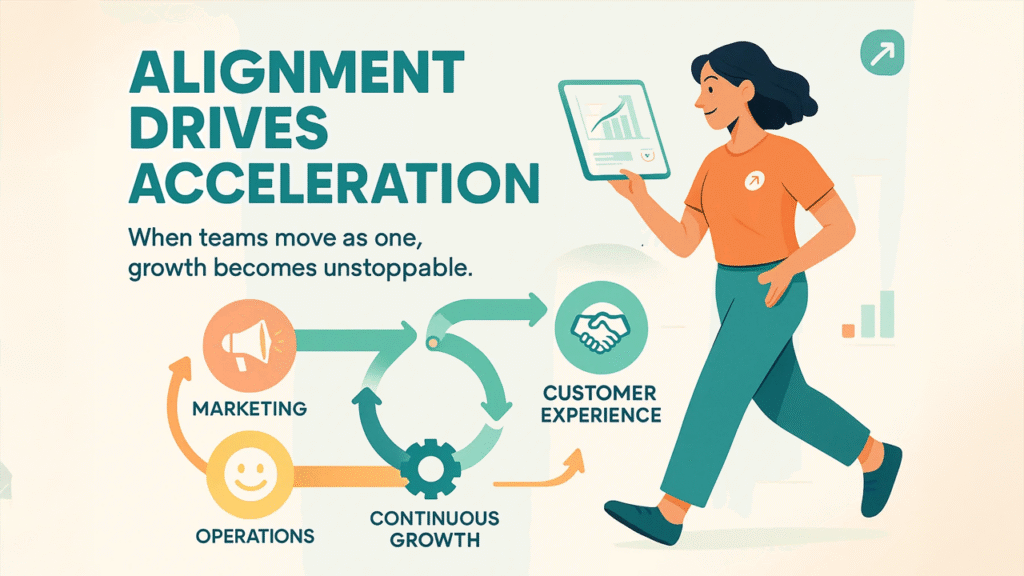
At a high level, growth marketing can be seen as a process of facilitating continuous iteration based on data-learning and speed. This requires integration with the rest of the organization.
When alignment exists internally, marketing can develop campaigns that either sales (and/or their management) believes in, and operations can fulfill the experience with some assurance of exceeding the brand promise. When alignment exists, every aspect of the business has active contributions to the goal of growing the business, rather than operating as isolated engines toward growth.
To put it another way – growth marketing doesn’t just require creativity — it requires alignment.
The companies that achieve alignment experience:
- Faster execution – teams are quicker (and maybe even happier) when the goal and metrics are shared.
- Higher conversion rates – when the transition from marketing to selling is seamless, there are fewer lost opportunities.
- Better customer experience – customers receive consistent messaging and are engaged from first touch through post sales experience.
- Customer accountability – teams own the outcome of continued engagement collectively, rather than being accountable to a departmental assignment.
Alignment is not just a soft skill set – it is a structural advantage.
Where Misalignment Starts
Implementing silos is not usually intentional; it is usually the result of evolution.
- Separate Definitions of Success: Marketing measures success with impressions, leads, or engagement. Sales measures success in terms of revenue. Operations measures success based on the efficiency of delivery. There is no metric that deals with each other.
- Separate Tools and Data: CRM, analytics, and marketing automation systems don’t work well together. As a result, teams have to deal with incomplete information, insights, or data.
- Different Storytelling: Marketing promises attractive things. Sales makes things up as they go. Operations does their best to deliver what can be done. The customer gets a mixed bag.
- Lack of Leadership: Executives do not repeat a unified strategic bump and then individuals are incentivized to succeed for themselves instead of as a group.
Growth marketing does not work if you don’t have a singular version of truth. A marketing plan will merely be a hypothetical exercise removed from the world of execution.
Frameworks for Creating Cross-Department Alignment
Realigning is not about an increase in meetings or slack channels. It is more about creating co-created frameworks for collaboration that makes alignment a part of the operation, not a step.
The Shared OKR Model
Objectives and Key Results (OKRs) should be established at your organization’s highest level and then allowed to trickle down to each team or functional area.
An example objective at the company level might be to increase customer lifetime value (CLV) by 20 percent.
- Marketing might have a KR to improve the lead qualification process and to run campaigns focused on retention.
- Sales’ might have a KR to increase upsell rates by 15 percent.
- Operations might have a KR to improve the onboarding process, which in turn is expected to reduce churn.
In this way Shared OKRs shift growth marketing from just a marketing goal, initiative, or function, to a goal, initiative, or function that the entire organization is aligned around and reflects the same business outcome.
The Feedback Loop Framework
Growth thrives on feedback. Create a feedback loop on a recurring cycle. For example,
- Marketing provides campaign data and collects customer sentiment even after the touchpoint.
- Sales shares feedback on lead quality and any common objections that arise during calls.
- Operations will share common service or delivery complaints that are also impacting satisfaction.
Formalizing these feedback loops allows every campaign iteration to improve not only marketing performance, but organizational alignment as well.
The Revenue Council
Create a cross functional “Revenue Council” that meets on a monthly basis. This council should include leaders from marketing, sales, and operations.
Take the approach of asking this group to review the complete customer journey, diagnose friction points, and make decisions together and collaboratively.
One key distinction from old-style meetings is that recommendations that emerge from the discussion of the council should change how the marketing plan evolves each quarter, so that the strategy and tactics in marketing align with what reality is happening, instead of what assumptions were made.
Shared Customer Narrative
All teams must work from a shared customer narrative.
- Who is the ideal customer?
- What issues are we addressing?
- What commitments are we making?
- How do we assess customer satisfaction and retention?
When all of the narratives are in agreement, messaging, delivery, and service reinforce each other. That allows trust to accelerate growth – the ultimate multiplier.
The Path Forward: Alignment as a Differentiator
The organizations that will dominate in growth for the next decade aren’t necessarily the biggest in budget or the flashiest in tool sets. They will be the organizations where alignment is resonated in culture.
Because the future of growth marketing won’t just be a matter of market savvy, it will be about organizational harmony. Every department that touches the customer must move in unison. Marketing, sales, and operations are not separate, they are part of a continuous growth system.
When your marketing plan is based on continuity, your business will not just grow: it will scale strategically.
Conclusion
Growth marketing cannot be effective without alignment internal, because there are no budget whether thin or extensive that will outpace organizational static.
If marketing can drive engagement that sales cannot convert, or sales can create opportunities that operations cannot reconcile, the brand will lose credibility. Misalignments do not just pull reversals, they stall growth.
The solution is not about a new campaign or an improved tool. It’s about an attitude and systematic shift that brings teams together with common goals, common data, and common ownership.
The most progressive companies of tomorrow will be those in which each department speaks the same growth language — not from platitudes, but from joint action.
Alignment is not the last step in a marketing plan. It’s the first step.