Mongolia eVisa for Citizens of China
Are you planning to cross the border into the “Land of the Eternal Blue Sky”? Whether you’re a trekker looking for the vast steppes of the Gobi, a sports enthusiast attending a Nadaam-related event, or simply transiting through Ulaanbaatar on your way to Europe, getting your travel documents in order is step one.

For citizens of the People’s Republic of China, the Mongolia eVisa has revolutionized the way travelers prepare for their journey. No more waiting in long queues at the embassy; everything can now be handled online. In this guide, we’ll answer the most frequent questions and break down exactly what you need to know for a successful Mongolia eVisa application for Chinese Citizen.
Do Chinese Citizens Need a Visa for Mongolia?
Yes. While many countries enjoy visa-free entry, citizens of mainland China holding ordinary passports are required to obtain a visa before entering Mongolia. The good news is that the Mongolian government has included China in its eVisa program, making the process significantly faster and more accessible than traditional paper visas.
What are the Available Mongolia eVisa Types for Chinese Travelers?
When applying for your Mongolian eVisa, it is crucial to select the category that accurately reflects the purpose of your visit. Each of these electronic visas is valid for a 150-day window from the date of issuance, but the permitted duration of stay varies:
- Tourism (K2): This is the most popular choice for travelers visiting for sightseeing, photography, or visiting friends. It allows for a single entry into the country with a maximum stay of 30 days. It is the perfect option for those wishing to explore the Khuvsgul Lake or the Altai Mountains.
- Transit (K6): If you are passing through Mongolia to reach a third country (commonly used by those on the Trans-Siberian Railway), the K6 visa is required. This single-entry visa allows for a shorter stay of up to 10 days, providing enough time to experience Ulaanbaatar before continuing your journey.
- Sports or Cultural Events (K4): Designed specifically for athletes, performers, or attendees of sanctioned cultural festivals and competitions. Like the tourism visa, it allows for a single entry and a stay of up to 30 days. You may be required to provide details regarding the specific event you are attending.
How Long is the Mongolia eVisa Valid for Entry?
All standard eVisas for Chinese citizens come with a 150-day validity period. This means you must enter Mongolia within 150 days of your visa being issued. If your plans change and you miss this window, you will need to apply for a new visa.
Is the Mongolia eVisa a Multiple Entry or Single Entry Visa?
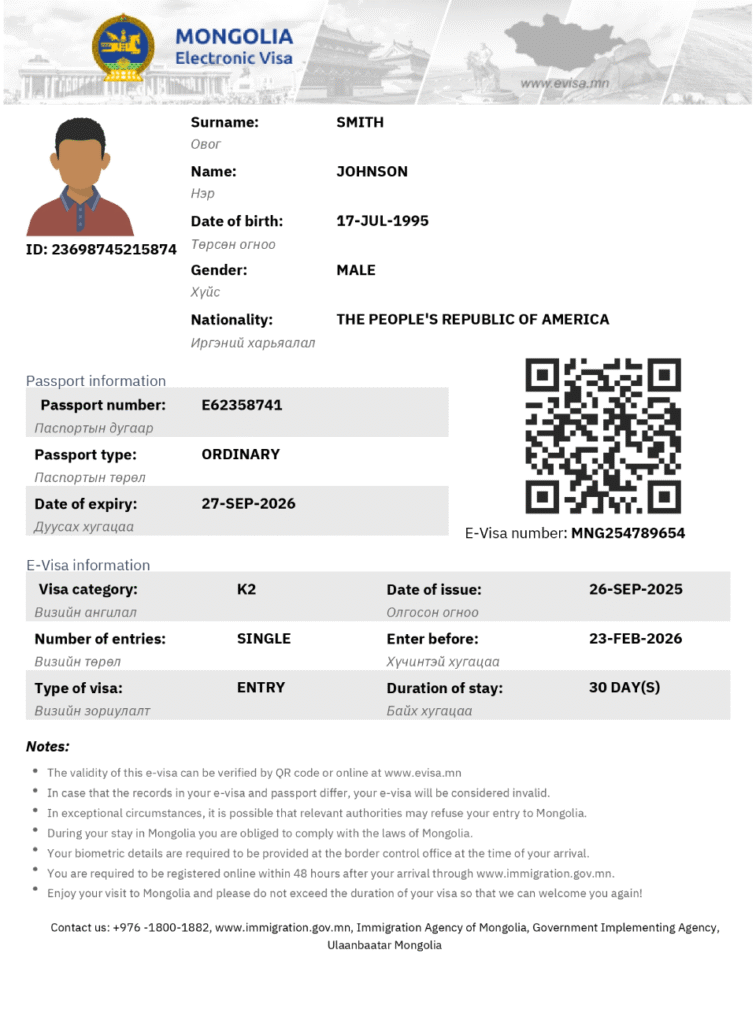
No. The current eVisa system for the K2, K4, and K6 categories only issues Single Entry visas. If you plan to leave Mongolia and re-enter during the same trip, you would typically need to apply for a traditional multiple-entry visa through the Mongolian Embassy.
How Long Does the Mongolia eVisa Processing Take?
We understand that travel timelines can be unpredictable, ranging from meticulously planned year-long expeditions to last-minute business trips or spontaneous getaways. To ensure every traveler can get their documents in time, we offer three tiered processing speeds:
- Standard Processing: 9 – 11 Working Days. This is our most economical option and is highly recommended for travelers who are planning their trip at least a month in advance. It allows for a thorough review by immigration officials during normal business cycles.
- Rush Processing: 5 – 9 Working Days. If your departure date is approaching quickly and you haven’t secured your visa yet, the Rush option prioritizes your application in the queue to ensure you receive your approval within approximately one business week.
- Super Rush Processing: 3 – 5 Working Days. This is the fastest available service for urgent travel needs. Our team works around the clock to expedite the verification and submission process, making it the ideal choice for emergency trips or cases where a visa is needed almost immediately.
What are the Document Requirements for a Mongolia eVisa?
To guarantee a high approval rate and avoid the frustration of a rejected application, you must provide clear, high-quality digital copies of the following documents required for Mongolia eVisa. Accuracy is key to avoiding delays:
- Passport Bio Page: A clear, color scan of your passport’s information page. Your passport must have at least 6 months of validity remaining from your date of entry.
- Applicant Photo: A recent, professional passport-style digital photograph taken against a plain white background.
- Financial Proof: Evidence that you have the means to support yourself during your stay (e.g., credit card statements or liquid assets).
- Your Travel Itinerary: A detailed plan of your stay, including intended entry and exit dates and the regions you plan to visit.
- Accommodation Proof: Confirmed hotel bookings, rental agreements, or a formal invitation letter if you are staying with a local host.
- Bank Statements: Recent monthly statements (usually the last 3 months) showing consistent financial activity and sufficient balance.
- Employment Letter: An official letter from your employer stating your position, salary, and the dates of your approved leave.
- Vaccination Certificates: Documentation of required vaccinations. While policies can shift, keeping your “Yellow Book” or digital health records ready is essential.
- Travel Insurance: Though sometimes considered optional, we highly recommend comprehensive travel insurance that covers medical emergencies and repatriation.
- Additional Bank Records: For certain applications, secondary financial verification may be requested to ensure total transparency of funds.
What are the Common Reasons for Mongolia eVisa Rejection?
The most common pitfalls include blurry passport scans, mismatched names (ensure they match your passport exactly), and insufficient financial proof. Using a professional service like evisa-mongolia.com ensures that experts review your documents before submission, drastically reducing the risk of rejection.
Can I Apply for a Mongolia eVisa Online from China?

Absolutely. The entire process is 100% digital. You can complete the Mongolia eVis application from your smartphone or laptop. Once approved, the eVisa is sent directly to your email. You simply need to print it out or keep a digital copy on your phone to present to border officials upon arrival.
What Happens If My Mongolia Travel Dates Change?
As long as your new travel dates still fall within the 150-day validity window of your issued eVisa, you do not need to change the visa. However, if your trip is delayed beyond that window, the visa will expire and you must re-apply.
Can I Still Use My Visa if I Didn’t Travel on the Intended Date?
If your visa has not yet expired (it is within the 150-day validity window), you can still use it to travel even if your specific arrival date has changed from what you originally stated. However, if the 150 days have passed and you have not used the visa, it becomes invalid and cannot be “re-activated.” You must submit a fresh application.
How Many Times Can I Enter Mongolia Each Year?
There is no strict limit on how many separate eVisas a Chinese citizen can apply for in a year. However, since each eVisa is for a single entry, you must apply for a new one every time you plan a new trip. Be mindful of the stay limits (30 days for tourism) to avoid overstaying, which can lead to fines or future entry bans.
Can I Change My Arrival Airport After the eVisa is Approved?
Generally, the Mongolia eVisa allows entry through major international checkpoints, including the Chinggis Khaan International Airport and several land borders like Zamyn-Uud. While it is best to enter through the point stated on your application, minor changes to your arrival airport are usually permitted as long as the port supports eVisa entry. However, if your project involves specific land border restrictions, it’s safer to stick to your approved itinerary.
How Does Taxi and Transport Work for Foreigners?

In Ulaanbaatar, you can find official taxis, but many locals also act as “informal” taxis—you simply wave your hand at the road. For a safer experience, we recommend using ride-hailing apps like UBCab. For travel between cities or into the Gobi, hiring a private van with a driver or using the domestic rail network is the most common way to get around.
Is a Private eVisa Agency Worth the Service Fee?
Applying through a private agency like evisa-mongolia.com is highly recommended for those who want a “stress-free” experience. The fee covers professional document review (to prevent rejection), 24/7 customer support in your language, and faster processing handling. For most travelers, the cost is well worth avoiding the risk of a rejected application and lost travel deposits.
What are the Healthcare Facilities Like for Tourists in Mongolia?
While Ulaanbaatar has modern private hospitals and clinics (such as SOS Medica), healthcare facilities in rural areas and the Steppes are extremely limited. This is why Travel Insurance is so strongly recommended; in the event of a serious medical issue outside the capital, emergency evacuation may be necessary.
Do I Need an International Driving Permit (IDP) in Mongolia?
If you plan to rent a vehicle and drive yourself across the Mongolian landscape, you must have a valid International Driving Permit along with your Chinese driver’s license. Mongolia is a signatory to the Vienna Convention on Road Traffic, so an IDP is legally required for foreign drivers.
What Should You Know About Arriving in Mongolia from China?
Whether you are taking the Trans-Mongolian Railway from Beijing or flying into Ulaanbaatar, remember to keep your printed eVisa and your passport together. Immigration officers will scan the QR code on your eVisa to grant entry.