
HACCP Certification for Meat, Poultry, and Seafood Processors What It Really Feels Like on the Ground
It Starts as Paperwork… Then It Becomes Something Else
At first glance, HACCP certification looks like paperwork. Charts, logs, temperature records—things you fill out, file, and move on from. Naturally, most meat, poultry, and seafood processors approach it that way. And honestly, that makes sense. When your production line is running fast and margins are tight, anything that feels administrative tends to get pushed aside.
However, HACCP certification doesn’t stay “just paperwork” for long. Instead, it gradually creeps into your routines. Over time, it starts changing how decisions are made. In fact, almost quietly, it shifts from being a requirement to becoming part of how your facility thinks and operates.
So, What Does HACCP Certification Really Mean Day to Day?
On paper, HACCP certification is about identifying hazards, controlling risks, and documenting processes. While that’s the official version, the reality on the processing floor feels different.
For instance, it shows up when a supervisor pauses a line because a temperature reading looks off. Likewise, it’s there when a worker double-checks a sanitation step—not because someone’s watching, but because it has become second nature. Especially in meat and seafood processing, where freshness can change quickly, that instinct matters far more than any checklist.
The “We Already Do This” Mind-set
You’ll often hear, “We already follow hygiene practices. Why do we need HACCP certification?” And to be fair, that’s not entirely wrong. Most processors already have solid routines in place. They understand their craft well.
However, this is where things shift. Knowing something and proving it are two very different things. HACCP certification doesn’t just ask you to work safely—it requires you to demonstrate it consistently, clearly, and without gaps. As a result, that shift—from assumed control to documented control—is where many teams feel the real challenge.
A System That Thinks Ahead (Not Just Reacts)
In many ways, processing meat, poultry, or seafood is like managing a chain reaction. Even a small issue—such as temperature drift or cross-contamination—can escalate quickly. Without structure, teams tend to react only after something goes wrong.
By contrast, HACCP certification flips that approach. Instead of reacting, it asks a simple question: what could go wrong, and how do we stop it before it starts? Initially, this forward-thinking mindset may not feel natural. Nevertheless, with time and practice, operations begin to feel calmer. Consequently, there is less firefighting and more control.
Let’s Talk About the Floor—Because That’s Where It Matters
While theory is important, the processing floor is where everything truly happens. It’s noisy, fast, and sometimes chaotic. Workers are focused on throughput, timing, and coordination. Therefore, introducing HACCP certification into that environment can initially feel like adding friction.
That said, something subtle happens over time. As procedures become clearer and more predictable, the chaos begins to reduce. In turn, workers understand expectations better. Supervisors spend less time correcting mistakes. As a result, production often becomes smoother—not slower.
Critical Control Points: Not as Complicated as They Sound
At first, “Critical Control Points” may sound technical or even intimidating. However, in practice, the concept is quite simple. These are the specific moments where things can go wrong—and where you have the power to stop them.
For example, in seafood processing, this might involve strict temperature control during storage. Similarly, in poultry processing, it could involve cooking or chilling stages. Therefore, HACCP certification helps teams identify these points and give them the attention they deserve. Ultimately, it’s not about overcomplicating work—it’s about focusing on where precision matters most.
Documentation: The Love-Hate Relationship
Let’s be honest—documentation is where most resistance appears. Logs, forms, and records can feel repetitive and, at times, unnecessary.
However, here’s the contradiction: while documentation may feel tedious, it is also what gives HACCP certification its strength. After all, records tell a story. They demonstrate consistency and provide protection when questions arise.
Moreover, with the right systems—even simple digital tools—documentation gradually becomes less of a burden. Eventually, it turns into a routine process, much like clocking in.
Training People, Not Just Systems
One common mistake is treating HACCP certification as a system upgrade rather than a people-focused change. While systems are important, they only work if people understand and believe in them.
Therefore, training becomes essential. Not just once, but regularly. More importantly, training should not be dry or overly technical. Instead, it should connect procedures to real-world consequences. When workers understand the “why,” not just the “what,” engagement improves significantly. As a result, you can actually feel the difference on the floor.
Audits: Stressful, Yes—But Also Clarifying
Admittedly, no one enjoys audits. There’s pressure, scrutiny, and always that lingering question: “Did we miss something?”
Nevertheless, audits play a crucial role in HACCP certification. Not only do they ensure compliance, but they also highlight blind spots. In addition, they reveal patterns that may go unnoticed in daily operations. Sometimes, they even confirm that everything is being done correctly. And that reassurance, although often overlooked, is incredibly valuable.
The Cost Question (Because Everyone Thinks About It)
Of course, cost is always part of the discussion. Implementing HACCP certification requires time, effort, and resources. This may include training sessions, system updates, and even infrastructure improvements.
At first, it can feel like an expense without immediate return. However, over time, the picture begins to change. For instance, there are fewer product losses, reduced rework, and lower recall risks. Additionally, customer trust improves. Although these benefits may not seem dramatic, they accumulate steadily—and significantly.
Choosing the Right Certification Partner
Equally important is choosing the right certification body. After all, not all certification experiences are the same. The partner you select can influence whether the process feels smooth or overwhelming.
For example, organizations like Integrated Assessment Service provide not just audits, but also guidance. They help explain requirements and simplify the journey. As a result, for processors managing daily production pressures, this kind of support can make a meaningful difference.
When HACCP Certification Starts to Feel Natural
Interestingly, over time, HACCP certification stops feeling like an external requirement. Instead, it becomes internal—part of the company culture.
You’ll notice it in small but meaningful ways. For instance, a worker may correct a colleague without being asked. Similarly, a supervisor might identify a risk early. Although these changes may seem minor, they indicate a deeper shift in mind-set.
The Subtle Impact on Product Quality
While HACCP certification is primarily associated with safety, it also has a noticeable impact on quality.
When processes are controlled and consistent, product quality naturally improves. For example, meat cuts appear more uniform, poultry cooks more evenly, and seafood retains freshness longer. Therefore, these improvements are not accidental—they are a direct result of consistent practices.
There’s a Human Side to All This
It’s easy to view HACCP certification as purely technical. However, behind every system are people—teams working under pressure, striving to meet expectations.
When systems are designed to support rather than burden them, morale improves. Consequently, work feels less reactive and more structured. While it may not be perfect, it becomes far more manageable.
Small Wins That Build Confidence
Importantly, progress with HACCP certification doesn’t happen overnight. Instead, it develops gradually.
For example, a cleaner audit, fewer deviations, or better documentation are all small wins. Over time, these wins’ build confidence. As confidence grows, teams shift from reacting to problems to preventing them. Ultimately, that’s where real progress happens.
A Few Missteps Along the Way (Because They Happen)
Of course, no implementation is perfect. There will be confusion, resistance, and occasional frustration. This is completely normal.
What matters most is not expecting perfection from the start. HACCP certification is a process, not a one-time switch. Therefore, teams must learn, adjust, and refine continuously. Eventually, what once felt difficult becomes routine.
Why It Matters More Than It Seems
If we take a step back, the importance becomes clear. Meat, poultry, and seafood processing directly affects consumer health. That responsibility cannot be taken lightly.
In this context, HACCP certification provides a structured framework. It ensures that safety is not left to chance. Instead, risks are managed proactively, and consistency becomes standard practice.
And Then, It Becomes Part of the Identity
Over time, HACCP certification becomes more than just a system—it becomes part of the organization’s identity.
It reflects in daily operations, team behaviour, and product quality. Even if customers don’t see the system itself, they experience its results. And in a competitive market, that reliability speaks volumes.
Final Thoughts: It’s Not Just About Passing an Audit
Ultimately, if HACCP certification is treated as a one-time goal, its true value may be missed.
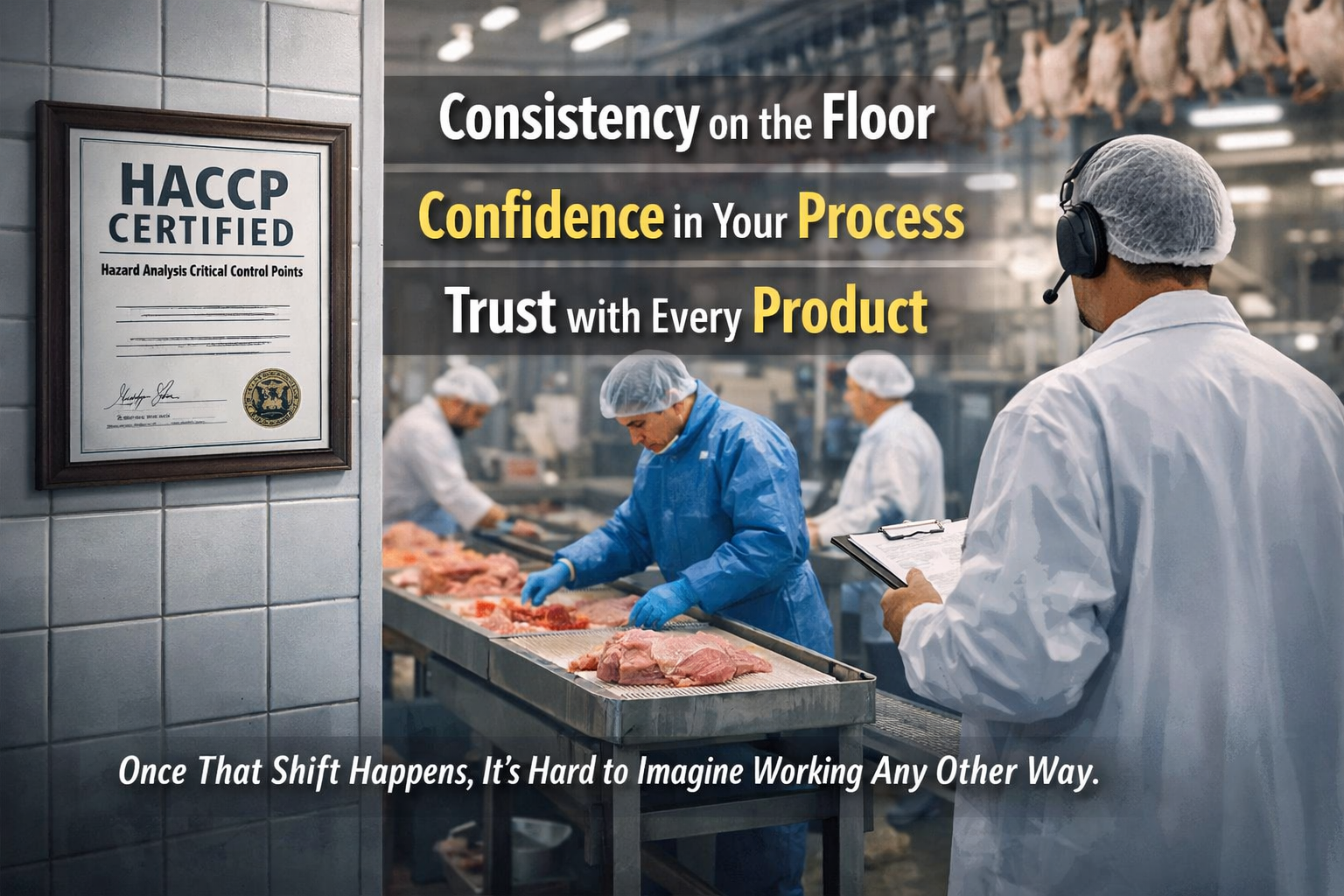
Because in reality, the real benefit isn’t the certificate on the wall. Rather, it’s the consistency on the floor, the confidence in your processes, and the trust you build with every product.
And once that shift happens, it becomes difficult to imagine working any other way.