


How a Countertop Visualizer is Changing the Way We Design Kitchens
Designing a kitchen used to be a guessing game.
You’d walk into a showroom, look at slabs under artificial lighting, hold a sample against your cabinet, and try to imagine how everything would come together. Sometimes it worked. Most times, it didn’t.
That’s exactly where a countertop visualizer changes everything.
Today, instead of imagining, you can actually see how a quartz, granite, or marble countertop will look in your own space — with your lighting, your cabinets, and your layout. And that simple shift from imagination to visualization is completely transforming how people make buying decisions.
Let’s break down how this works, why it matters, and how brands are leveraging it to drive faster conversions.
What is a Countertop Visualizer?
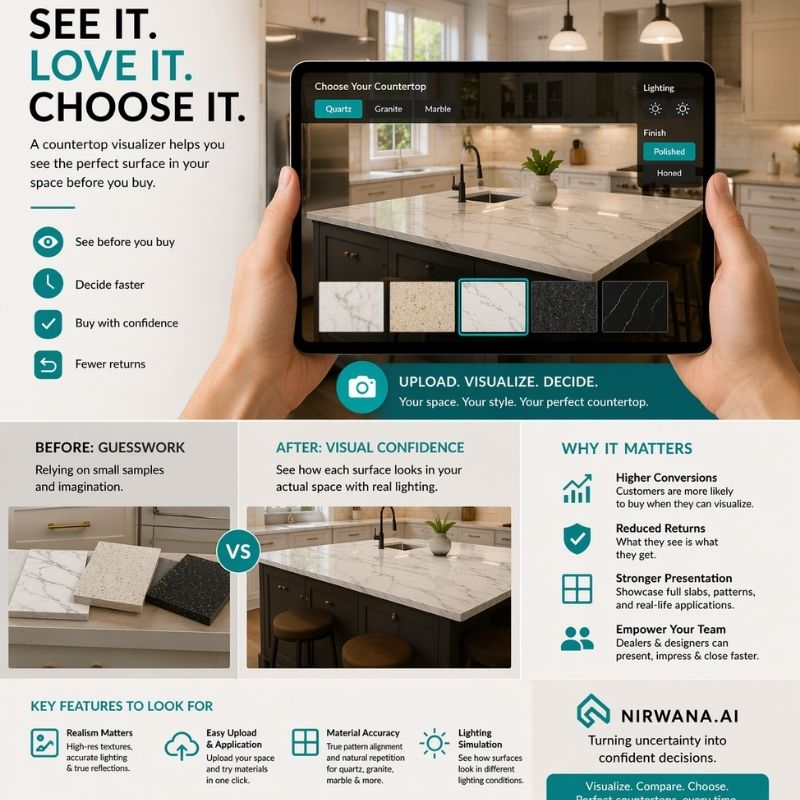
A countertop visualizer is a digital tool that allows users to preview different countertop materials in a real or sample kitchen environment.
Instead of relying on small samples, users can:
- Upload an image of their kitchen
- Choose from a catalog of materials (quartz, granite, marble, etc.)
- Instantly apply the surface to countertops
- Adjust lighting, angles, and finishes
The result? A near-realistic preview of the final outcome.
This isn’t just a design tool — it’s a decision-making accelerator.
Why Traditional Countertop Buying Falls Short
1. Samples Don’t Tell the Full Story
A 6×6 inch sample can’t show:
- Vein flow in marble
- Pattern repetition in quartz
- Color shifts under natural light
2. Showrooms Have Limited Context
Even premium showrooms can’t replicate your:
- Kitchen size
- Cabinet color
- Lighting conditions
3. Decision Fatigue is Real
Customers often delay purchases because they’re unsure:
“Will this look good in my space?”
This hesitation leads to:
- Lost sales
- Longer buying cycles
- Higher return rates
How a Countertop Visualizer Solves This
See Before You Buy
With a countertop visualizer, customers can instantly test multiple options in seconds.
Instead of imagining:
“I think this might work…”
They can confidently say:
“This is exactly how it will look.”
True-to-Life Visualization
Modern tools like Nirwana.ai focus on:
- Realistic lighting simulation
- Accurate texture mapping
- True-scale placement
This ensures that what users see is very close to reality — not just a rough mockup.
Faster Decision Making
When customers can visualize outcomes clearly:
- They decide faster
- They feel more confident
- They are less likely to second-guess
Real-World Example: From Confusion to Confidence
Let’s say a homeowner is choosing between:
- White quartz with subtle veining
- Bold marble with heavy patterns
In a traditional setting, both might look equally appealing.
But when applied using a countertop visualizer:
- The marble might overpower the space
- The quartz might create a cleaner, modern feel
That single visualization can instantly clarify the decision.
Why Brands Are Adopting Countertop Visualizers
1. Higher Conversion Rates
When customers see products in their own space, they’re far more likely to buy.
2. Reduced Returns
No more surprises after installation — expectations match reality.
3. Stronger Product Presentation
Instead of static catalogs, brands can showcase:
- Full slab views
- Pattern continuity
- Real-life applications
4. Empowering Dealers & Designers
A countertop visualizer isn’t just for end customers.
Dealers, architects, and interior designers use it to:
- Present options instantly
- Close deals faster
- Provide a premium experience
Key Features to Look for in a Countertop Visualizer
Realism Matters
Not all tools are equal. Look for:
- High-resolution textures
- Accurate reflections and gloss
- Proper shadow handling
Easy Upload & Application
Users should be able to:
- Upload room images easily
- Apply materials in one click
Material Accuracy
Especially for surfaces like quartz and marble:
- Pattern alignment is critical
- Repetition should look natural
Platforms like Nirwana.ai are pushing this forward by focusing heavily on visual accuracy and usability — making the experience seamless for both brands and users.
How It Impacts the Buying Journey
Before
- Browse catalogs
- Visit showroom
- Take samples
- Guess outcomes
After
- Upload kitchen photo
- Try multiple materials instantly
- Compare side-by-side
- Decide with confidence
This shift reduces friction at every step.
The Psychological Impact of Visualization
There’s a deeper reason why a countertop visualizer works so well.
When customers see a product in their own space, it triggers:
- Emotional connection
- Ownership feeling
- Reduced uncertainty
This is the same principle used in industries like:
- Furniture (AR placement)
- Paint (wall visualizers)
- Flooring (room previews)
Visualization bridges the gap between interest and purchase.
Future of Countertop Visualization
We’re just getting started.
In the coming years, countertop visualizers will evolve with:
- AI-based design suggestions
- Voice-driven customization
- Real-time lighting simulation
- Integration with e-commerce platforms
Imagine saying:
“Show me a modern kitchen with dark cabinets and a subtle quartz finish”
And getting an instant, realistic preview.
That’s where the industry is heading.
Final Thoughts
A countertop visualizer is no longer a “nice-to-have” — it’s becoming a necessity.
In a market where customers expect clarity, speed, and confidence, visualization tools are redefining how decisions are made.
Whether you’re a homeowner, designer, or brand, the ability to see before you buy is powerful.
And platforms like Nirwana.ai are helping bring that clarity to life — turning uncertainty into confident decisions.