

How to Decorate Your Living Room on a Budget in India
Most living room makeover content you find online assumes two things: a large, well-lit room and a budget that isn’t really a budget. Neither describes most Indian homes.
Indian living rooms — especially in cities — tend to be compact. Natural light can be inconsistent. And the real challenge isn’t finding ideas, it’s figuring out which ideas actually work when you’re spending carefully and the room is 150 square feet, not 400.
This guide is built around that reality. Not aspirational showroom setups — practical decisions that create a noticeably better-looking living room without requiring you to spend a lot or start from scratch.
Start With What’s Already There — Before Buying Anything
The single most common decorating mistake is buying new things before dealing with what’s already in the room. A room that’s rearranged thoughtfully will look more transformed than one where new objects are placed on top of existing clutter.
Before spending anything, do this: take everything off your shelves and surfaces. Put it all in a pile. Now look at the room. Notice what the space feels like when it’s empty — where the light falls, what the natural focal point is, where your eye goes first.
Then add back only what earns its place. In most Indian living rooms, this exercise alone removes 30–40% of what was on display — and the room immediately looks more intentional. The things that come back in should either be genuinely useful, genuinely beautiful, or carry real meaning. Anything else is just visual noise.
The One-Anchor-Piece Rule — Spend Here, Save Everywhere Else
Budget decorating works best when you’re strategic about where the money actually goes. The most effective approach: identify one anchor piece per room — the thing that carries the visual weight — and spend your best budget there. Everything else can be simple, inexpensive, or repurposed.
In a living room, the anchor is usually one of three things: the sofa, a piece of wall art, or a standout decor object. For people decorating on a genuine budget, the sofa is often already there and replacing it isn’t realistic. That leaves wall art and decor objects — both of which can be high-impact without being high-cost.
A single well-chosen decorative artifact — something with genuine visual presence, placed in the right spot — does more for a room than ten smaller, forgettable pieces. This is where the budget thinking should start. The supporting pieces around it can be minimal.
Walls Are Free Real Estate — Use Them
In compact Indian living rooms, floor and surface space is limited. The walls aren’t. Yet most people leave them almost entirely bare or hang a single calendar that does nothing for the room.
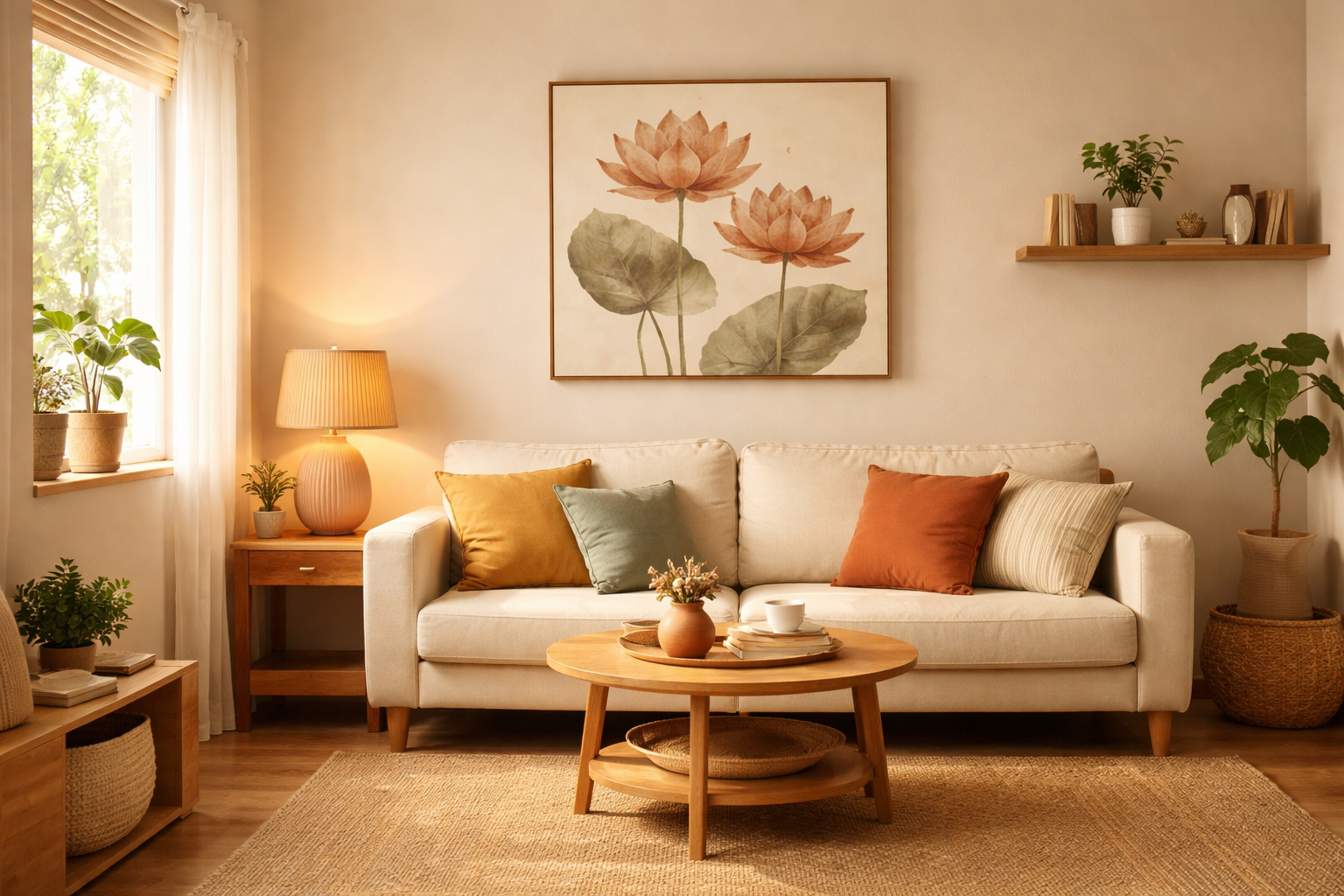
An accent wall doesn’t require paint. Even without it, a thoughtfully arranged wall — a few frames of different sizes, a small shelf with objects on it, or a single large piece of art — creates a focal point that makes the whole room feel more considered. If you do paint, a single wall in a warm earthy tone (terracotta, warm ochre, sage) can shift a room’s personality entirely.
For budget-conscious decorating, wall space gives the highest visual return per rupee. A canvas that costs ₹800–1,500 can anchor an entire wall in a way that a ₹500 surface object never will — purely because of scale.
One detail most people get wrong: hanging things too high. In Indian homes with standard 9–10 foot ceilings, the center of any wall piece should sit roughly at eye level when standing — around 57–60 inches from the floor. This one correction makes a visible difference.
Lighting Is the Cheapest Upgrade Most People Skip
Almost every Indian living room relies entirely on one ceiling light. That light — usually a cool-toned LED — flattens everything in the room. It removes depth, eliminates shadow, and makes even nicely arranged spaces look a little clinical.
Adding one warm-toned secondary light source changes things completely. A decorative table lamp in a corner, a small floor lamp behind the sofa — the ceiling light becomes the functional option when you need it. The secondary source creates atmosphere the rest of the time.
A lamp with a well-designed base sitting on a side table is doing two jobs at once — light source and decor object. For budget decorating, that kind of double-duty thinking matters. You’re not buying a lamp, you’re buying a corner of the room.
How to Style a Shelf Without It Looking Staged
Shelves and console tables are where most living room decorating goes wrong. Either completely bare, completely full, or filled with objects that have no relationship to each other.
A framework that works consistently — vary height, not quantity:
- Anchor with the tallest object first — a vase, a sculpture, a stack of books with something on top. This gives the arrangement its spine.
- Add one or two mid-height objects — they bridge the tall anchor and the surface below.
- Finish low — a small object, a candle holder, a flat tray. This grounds everything above it.
- Leave deliberate gaps — negative space isn’t emptiness, it’s what lets the objects breathe.
Odd numbers (3 or 5 objects) almost always look more natural than even groupings. Vary texture too — something smooth next to something matte, something natural next to something more refined.
Textiles — The Most Underrated Budget Decor Tool
Changing cushion covers — not the cushions themselves, just the covers — is a ₹300–600 change that can make a living room look like it was professionally styled. A throw blanket draped over one end of a sofa adds warmth and texture. A small dhurrie or woven rug under the coffee table defines the seating area and makes the room feel more complete.
Choose textiles in colors that belong to the same family as what’s already in the room — not matching exactly, but belonging. Earthy tones (terracotta, warm ochre, sage, mustard) work across most Indian living room palettes and are widely available at accessible price points.
Small Living Room? A Few Things That Consistently Help
- Keep the floor as clear as possible — visual clutter at floor level makes a small room feel smaller faster than anything else.
- Use vertical space — wall shelves and taller objects draw the eye upward, making ceilings feel higher.
- One large piece of art works better than several small ones — multiple small frames fragment a compact wall.
- A mirror on a side wall adds perceived depth — a well-placed mirror can make a room feel visually 20–30% larger.
- Stick to the room’s primary color family — too many competing tones in a small space creates visual noise.
Spend Less, Choose Better
Budget decorating isn’t about spending the least everywhere — it’s about knowing which purchases are worth real money and which aren’t.
Worth spending on:
- One anchor decor piece — something with genuine presence that the room is built around
- A good lamp — works as both light and decor, and the quality shows
- Curtains — cheap curtains make an entire room look budget; good ones elevate everything around them
Worth saving on:
- Supporting decor objects — simple, inexpensive pieces that fill space around the anchor
- Cushion covers — high impact, very low cost, easy to replace as your taste evolves
- Trays and baskets — functional organizers that look good and cost very little
The One Thing That Separates Decorated From Styled
The rooms that look most put-together — regardless of budget — share one quality: every object in them was chosen, not just placed. Not expensive choices. Deliberate ones.
There’s a reason living rooms that treat decor as art consistently look better than those that treat it as shopping. If you want to understand the broader patterns shaping how Indian homes are being decorated this year, the context in home decor trends in India this year connects directly to what works at the budget level too — earthy tones, art-inspired objects, the shift toward pieces that carry meaning over volume.
A thoughtfully chosen decor piece does more for a room than ten generic filler objects. That’s not a luxury principle — it’s the most practical budget principle there is.
A thoughtfully chosen decor piece does more for a room than ten generic filler objects. That’s not a luxury principle — it’s the most practical budget principle there is.
Frequently Asked Questions
How can I decorate my living room cheaply in India?
Start by decluttering and rearranging what you already have — this costs nothing and often makes the biggest visible difference. Then focus budget on one anchor piece and keep everything around it simple. Changing cushion covers, adding a small rug, and introducing one warm light source are low-cost changes with high visible impact.
What decor items give the most impact in a living room?
Wall art, a decorative lamp, and one well-styled shelf give the most return in a living room. These three cover the main visual zones — walls, floor level, and surfaces — and together create the impression of a fully decorated space without requiring many individual purchases.
How do I make my small Indian living room look nice?
Keep the floor clear, use vertical wall space, and choose one large art piece over many small ones. A mirror on a side wall adds perceived depth. Stick to a consistent palette — too many tones in a small space creates visual noise.
What should I put on my living room shelf for decoration?
Use a mix of heights — one tall object, one or two mid-height pieces, one low object — and leave some empty space. Vary textures: something smooth next to something matte. Three to five objects in a loose triangular arrangement looks more balanced than a straight line.
What is a good budget for living room decoration in India?
A noticeable transformation is achievable in ₹3,000–8,000 if spent strategically. This could cover new cushion covers, one quality decor piece, a basic decorative lamp, and a small rug or throw. Spreading the same amount across many low-quality items gives a much weaker result.
Clear the Room. Find the Point. Build From There.
The sequence that works in every budget: clear the room, find the focal point, choose one anchor piece, add light, let everything else be simple.
That works in a ₹5,000 budget the same way it works in a ₹50,000 one. The anchor changes. The principle doesn’t.