

How Experts Detect Slab Leaks in Homes and Commercial Properties
Slab leaks are rarely obvious. Most of the time, they sit quietly under concrete floors, doing damage long before anyone realises something’s wrong. In Australian homes and commercial buildings, where concrete slab construction is common, these leaks are more than a plumbing issue. They’re a structural risk that builds up slowly.
Because the pipes are buried beneath the slab, you don’t see water pooling. You see side effects. A damp smell that doesn’t go away. Flooring that starts to lift. Water bills that keep climbing for no clear reason. By the time many people act, the leak has already been active for months.
Industry estimates suggest water leaks account for up to 10% of household water use in Australia, much of it from hidden pipe failures (Water Services Association of Australia). That’s why early, expert detection matters. Not just to save money, but to prevent long-term damage that’s far harder to reverse.
Early Signs Professionals Look For Before Any Tools Come Out
Before advanced equipment is used, experienced technicians rely on something simpler: patterns. Warm spots on tiled floors are often one of the earliest indicators, especially when hot water lines are involved. Hissing or faint dripping sounds can sometimes be heard late at night when everything else is quiet. Water meters that continue to run when all fixtures are off usually confirm that water is escaping somewhere it shouldn’t.
In commercial settings, the signs can look different. Unexpected pressure drops in fire systems. Persistent humidity in plant rooms or server areas. Musty smells that keep returning despite cleaning.
Outside the building, overly green patches of grass along slab edges or pathways can signal moisture migration underground. When these signs align with a 10–20% increase in water usage, experts know it’s time to investigate further.
Why Non-Invasive Detection Is the First Choice Today
Breaking concrete is expensive, disruptive, and often unnecessary. Modern leak detection focuses on locating the problem before a single tile or slab section is touched.
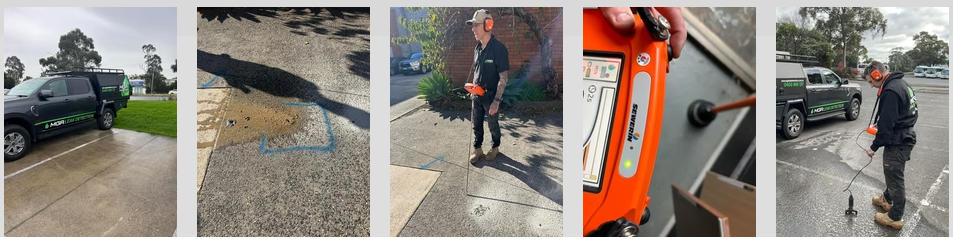
One of the most widely used techniques is acoustic detection. Ground microphones and electronic listening devices are placed at strategic points across floors, walls, and external surfaces. These tools amplify the specific frequencies created by water escaping under pressure, allowing technicians to separate leak noise from background sounds like traffic or appliances.
Infrared thermal imaging is often used alongside this. Leaking hot water creates temperature differences beneath the slab. On a thermal camera, these appear as irregular warm zones. In air-conditioned commercial buildings, the contrast is even easier to identify.
Pressure testing adds another layer of confirmation. Sections of the plumbing system are isolated and pressurised while digital gauges monitor for drops. A consistent pressure decline tells the story without excavation.
When Acoustic Correlation and Tracer Gas Come Into Play
Some leaks are harder to pinpoint, especially in dense urban environments or older buildings with complex plumbing layouts. That’s where acoustic correlators are used.
These systems place sensors at two points along a pipe. By measuring the time it takes sound waves to travel between them, the equipment calculates the exact leak location. It’s particularly effective in suburban areas where background noise can interfere with simpler listening devices.
For extremely small or stubborn leaks, tracer gas detection is often the final step. A hydrogen-nitrogen gas mixture is introduced into the pipe system. Because the gas is lighter than water, it escapes through even pinhole-sized leaks and rises through concrete or soil. Portable gas detectors then track its path.
This method is safe, non-toxic, and compliant with Australian safety standards. It’s especially useful in older properties where copper pipe corrosion is common.
Mapping and Visual Confirmation Before Any Cutting Happens
Once a leak is detected, experts still avoid cutting until they’re confident. Electromagnetic pipe locators are used to trace the exact route and depth of plumbing beneath the slab. Signal disruptions or unexpected deviations often mark the damaged section.
Borescope cameras may then be inserted through existing access points or small drill holes. These fibre-optic cameras provide live visuals of pipe interiors, showing corrosion, cracking, or joint failures. In large commercial buildings, robotic inspection units can be used to extend reach and capture full reports.
This layered confirmation ensures that when concrete is finally opened, it’s done once and in the right place.
What the Detection Process Actually Looks Like Step by Step
Professional slab leak detection follows a clear, repeatable process:
First, technicians gather background information. Water bills, renovation history, building age, and symptom timelines all matter. Next comes non-destructive scanning using acoustic tools and thermal imaging to narrow down the problem area. Isolation testing follows, shutting off fixtures and monitoring meter movement to confirm active leaks. Advanced methods like tracer gas or correlation are then used to lock in the exact location.
Finally, detailed documentation is provided. Photos, thermal images, pressure readings, and repair recommendations are aligned with AS/NZS 3500 plumbing standards. In most cases, this entire process takes a few hours, not days.
What Happens After the Leak Is Found
Detection informs the repair strategy. Small internal leaks may be sealed using epoxy pipe lining, avoiding slab cutting altogether. In other cases, pipes are rerouted through walls or ceilings to bypass the damaged section. Severe leaks may require targeted slab access, but only directly above the fault.
Commercial properties often take it a step further, installing monitoring systems that track pressure changes over time and alert facility managers early.
Post-repair testing ensures the system is stable before surfaces are restored.
Why Licensed Experts Matter in Australia
Slab leaks aren’t a DIY problem. An incorrect diagnosis can make damage worse and void insurance coverage. Licensed professionals operating under QBCC or equivalent state certification ensure compliance, safety, and accurate reporting.
Specialist firms with dedicated detection equipment, not just general plumbing tools, deliver better outcomes with less disruption.
Final Thoughts
Slab leaks develop quietly, but their impact is anything but small. Detecting them early requires experience, the right tools, and a methodical approach. When experts are involved from the start, damage is limited, repairs are targeted, and properties stay compliant.
If you suspect a slab leak, acting early isn’t just smart. It’s the difference between a manageable fix and a major structural problem.